













![[Valid RSS]](https://www.futsalfocus.net/wp-content/uploads/2020/01/valid-rss-rogers.png "Validate my RSS feed")

Estimated reading time:7 minutes, 23 seconds
A dramatic nine-goal final in Nakhon Ratchasima saw Thailand overturn Australia with a decisive five-minute burst, securing their first ASEAN women’s futsal title.
A final with nine goals usually gets described as chaos. But Thailand’s 5–4 win over Australia at the ASEAN Women’s Futsal Championship 2026 wasn’t random, it was a referendum on two of futsal’s sharpest edges: restarts and in-game defensive adjustment.
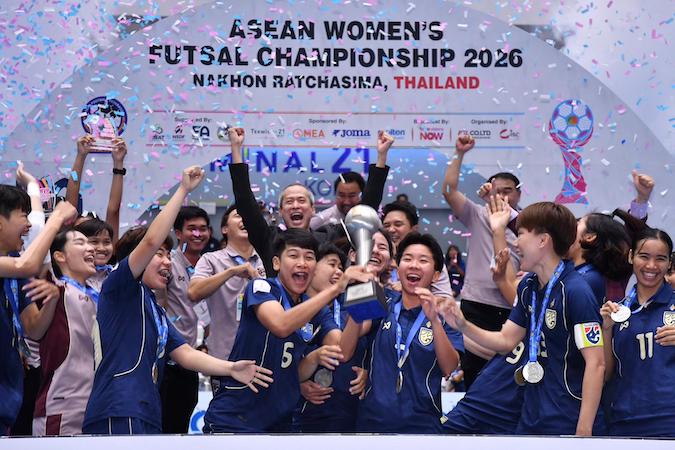
(Main image: Thailand are champions of the 2026 ASEAN Women’s Futsal Championship – source of the image: ASEAN website)
Hosted in Nakhon Ratchasima from 24 February to 2 March 2026, the tournament’s second edition was played entirely at Terminal21 Hall inside Terminal 21 Korat, a venue built for high-tempo indoor spectacle with around 3,500 stadium seats.
Thailand lifted their first ASEAN Women’s Futsal Championship title, finishing with a perfect 4–0 record and surviving a breathless final that swung on a single “momentum window”: minutes 31 to 36—five minutes that decided the championship.
The tournament in one number: 5.0 goals per game
Across 13 matches, the championship produced 65 goals, an average of exactly five goals per match, reflecting the region’s increasingly aggressive women’s futsal identity: brave presses, fast restarts and the willingness to attack with numbers.
Australia, debutants in the competition, topped their group and reached the final; Vietnam rebounded to claim bronze; Indonesia and the Philippines showed flashes of promise; Myanmar and Malaysia endured difficult campaigns but gained valuable tournament experience.
In the third-place match, Vietnam defeated Indonesia 4–1 after overturning a first-half deficit, with goals from Le Thi Thanh Ngan, Tran Thi Thuy Trang, Nguyen Phuong Anh and an Indonesian own goal.
But the tournament’s defining image became Thailand lifting the trophy after a final that felt like a mini-season compressed into 40 minutes.
Australia’s debut run: credible, composed, and historic
Australia didn’t drift into the final on adrenaline alone. Their run to the championship match represented the nation’s best result at the ASEAN Women’s Futsal Championship, marking the first time Australia finished runners-up in the competition.
Before the tournament began, the event had been framed as an important development step for the national program. Australia entered the championship as debutants and were drawn in Group B alongside defending champions Vietnam, Myanmar and the Philippines.
With seven nations competing for the regional title, the tournament provided Australia with valuable international match experience and an opportunity to integrate new players into the national setup.
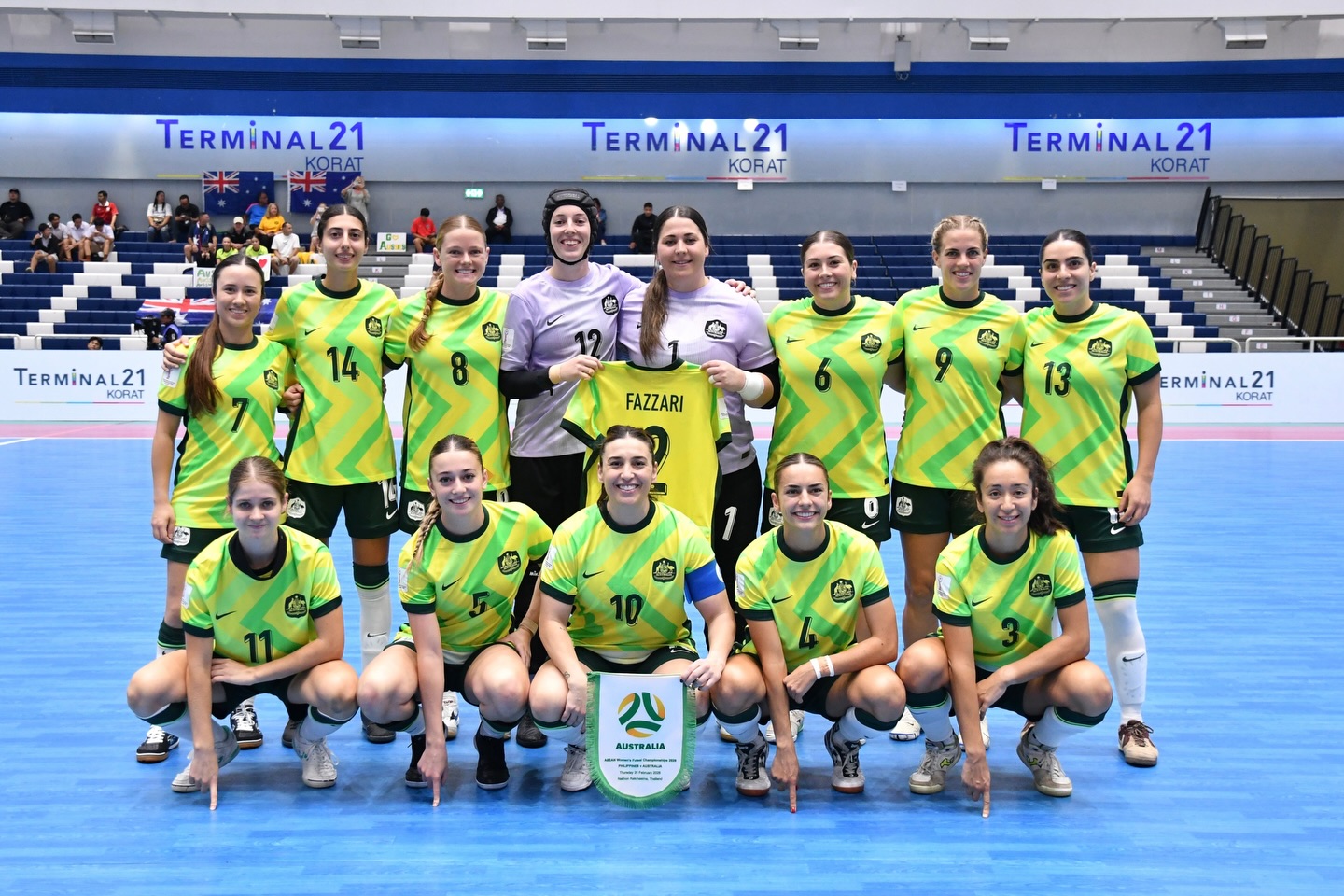
Australian Women’s national futsal team – history makers! Source of the image: Football Australia Facebook page
Under head coach Brunno Cannavan, the squad blended experienced futsal players with emerging talent and quickly proved capable of competing with Southeast Asia’s strongest teams.
Ahead of the tournament, Cannavan emphasised the developmental value of the competition.
“We’ve selected a squad that blends experience with fresh energy, including eight players who were not part of our last international window,” Cannavan said.
“The ASEAN Women’s Futsal Championship will give us meaningful match minutes against quality opposition, and that’s crucial for our growth and development.”
At the time, the focus was on building squad depth and giving emerging players international exposure. By the end of the tournament, that developmental objective had unexpectedly turned into a run to the final.
Australia’s path included:
• A statement win over Vietnam (2–0) in the group stage.
• A semi-final victory over Indonesia in extra time.
Most importantly, Australia repeatedly showed a trait that travels well in international futsal: emotional reset. They conceded first in the semi-final, trailed again later, and still found solutions.
That resilience appeared again in the final. But this time the match turned into a restart-heavy knife fight—and Thailand were slightly better equipped for it.
Australia squad – ASEAN Women’s Futsal Championship 2026
Grace Arnold — Pivo
Jessica Au — Ala
Ariella Cabezas — Ala
Trudy Camilleri — Pivo
Brianna Clarke — Goalkeeper
Sarah Maree Easthope — Goalkeeper
Nikkita Fazzari — Ala
Claudia Fruscalzo — Pivo
Clare Holder — Fixo
Alexia Elisabeth Karrys-Stahl — Fixo
Alvina Khoshaba — Ala
Mia Nataly — Ala
Halle Smit — Ala
Natalie Tathem — Ala
Head Coach: Brunno Cannavan
Thailand’s home advantage wasn’t volume—it was control
Home crowds can give you energy. They don’t automatically give you clarity.
Thailand’s advantage throughout the tournament was their composure in pressure moments: the first kick-in after conceding, the corner under fatigue, the free kick when defensive organisation mattered most.
Thai match reporting noted Thailand’s starting group in the final, with captain Darika Peanpailun acting as the attacking reference point. What stood out wasn’t a radical tactical system but the certainty of roles inside familiar patterns.
That matters because high-scoring futsal finals are often decided by the team with the clearest “next action” after disruption.
Thailand had it.
Thailand squad – ASEAN Women’s Futsal Championship 2026
Goalkeepers
Sasiprapha Suksen
Nuengruthai Sorahong
Defenders
Pititta Moolphio
Hataichanok Tappakun
Nattamon Artkla
Panwasa Kingthong
Wingers / Midfield
Jenjira Bubpha
Sangrawee Meekham
Sasikarn Tongdee
Lalida Chimpabut
Saovapha Tranga
Darika Peanpailun
Pivots
Paerploy Huajaipetch
Arriya Saetoen
Head Coach: Thanathorn Santanaprasit
The final: nine goals, but not nine random events
A restart-heavy match by design
The official scoring summary tells the story of a dramatic contest.
Thailand scored through Sangrawee Meekham (5’), Jenjira Bubpha (19’) and a Darika Peanpailun hat-trick (31’, 35’, 36’).
Australia’s four goals included strikes from Alexia Elisabeth Karrys-Stahl (24’) and Nikkita Fazzari (40’), as well as two own goals — a deflection credited to Sangrawee Meekham in the 17th minute and another from goalkeeper Sasiprapha Suksen in the 24th.
But the tactical story beneath that summary is even clearer: the final repeatedly rebooted itself through restarts—corners, kick-ins and free kicks—creating a match rhythm where one lapse in marking, wall discipline or near-post protection could instantly become a goal.
Thailand didn’t win because they were luckier.
They won because they were more repeatable in the repeatable phases of futsal.
The hinge: minutes 31–36 (The Five-Minute Flip)
Australia’s best stretch came when they turned a 2–2 scoreline into a 3–2 lead, including a direct free kick that cut through the defensive wall.
And then the title swung.
From the 31st to the 36th minute, Thailand scored three times — a burst that is rare at elite level unless something structural changes.
31’ (3–3): Darika converts from a set-piece sequence.
35’ (4–3): a quicker combination phase opens space and Darika finishes again.
36’ (5–3): a penalty completes the turnaround.
Thai match coverage suggested Thailand increased the height and tempo of their press after falling behind, disrupting Australia’s ability to play out comfortably and creating attacking situations closer to goal.
When futsal is played at that higher pressure level, possessions shorten, defensive mistakes multiply, and restarts occur in more dangerous areas.
Thailand effectively turned the match into the version of futsal where they held the advantage.
Player axis: Darika as the reference point, Jenjira as the spark
The tournament statistics reinforced what the final already suggested.
Thailand captain Darika Peanpailun was named the tournament’s Most Valuable Player, while teammate Jenjira Bubpha finished as the competition’s top scorer. Australia’s Sarah Maree Easthope received the Best Goalkeeper award.
For Thailand, the attacking structure was built around two complementary roles.
Darika functioned as the finisher and pressure valve — a pivot capable of converting tight chances and anchoring attacking movements.
Jenjira provided the spark around her, arriving at the near post, drifting into pockets of space and helping transform restart situations into immediate shooting opportunities.
For Australia, the late goal at the 40-minute mark mattered less than what it symbolised: even after Thailand’s five-minute surge, they continued attacking.
Tournament top scorers
| Player | Team | Goals |
| Darika Peanpailun | Thailand | 5 |
| Jenjira Bubpha | Thailand | 5 |
| Clare Holder | Australia | 4 |
| Biện Thị Hằng | Vietnam | 4 |
| Alexia Karrys-Stahl | Australia | 3 |
| Nikkita Fazzari | Australia | 3 |
| Nisma Rusdiana | Indonesia | 3 |
Closing: a classic, explained
Thailand beat Australia 5–4, but the number that will echo most clearly for coaches is 31–36 — the five minutes where Thailand turned a final into a finish.
Nine-goal matches get remembered for drama.
Titles are usually decided by the quieter mechanisms underneath: restarts, adjustments and the ability to remain composed under pressure.
In the decisive moments of the ASEAN Women’s Futsal Championship 2026 final, Thailand looked the most comfortable in that environment.
And that is why they left Nakhon Ratchasima as champions.
Organ Donation
Futsal Focus is a supporter of Dáithí Mac Gabhann and his family’s campaign to raise awareness of Organ Donation. We encourage our readers to learn more about Organ Donation: https://www.organdonation.nhs.uk/
Futsal Focus
You can read more articles about International Futsal by going to the top navigation bar or by clicking here
If you like this article and would like to keep updated on Futsal news, developments, etc. You can now follow Futsal Focus via Google News. By following our page which will send you an alert as soon as we publish an article. Please click here and follow us on Google.
You can also keep updated on Futsal news, developments by submitting your email below in the Subscribe to Futsal Focus option.
Follow Futsal Focus by clicking on Facebook, Twitter, or Instagram or on the social media buttons on the website




