














![[Valid RSS]](https://www.futsalfocus.net/wp-content/uploads/2020/01/valid-rss-rogers.png "Validate my RSS feed")

Estimated reading time:6 minutes, 14 seconds
From record crowds in Jakarta to a historic first final, Indonesia’s AFC Futsal Asian Cup 2026 signalled both arrival and ambition.
When the AFC Futsal Asian Cup 2026 arrived in Jakarta, Indonesia was entrusted with more than hosting rights. It was handed an opportunity, to prove its organisational capability, to test its national team against Asia’s elite, and to elevate futsal’s standing within the country’s sporting landscape.
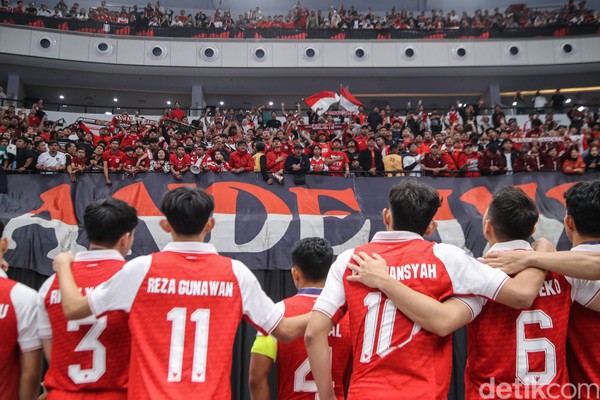
(Main picture source: Rifkianto Nugroho/detikfoto)
By the time the tournament concluded at the Indonesia Arena, Indonesia had achieved all three.
Although the hosts fell 5–4 on penalties to Iran after a 5–5 draw in extra time in the final, the broader verdict across Indonesian media, government, and federation leadership was unmistakable: this was a defining breakthrough.
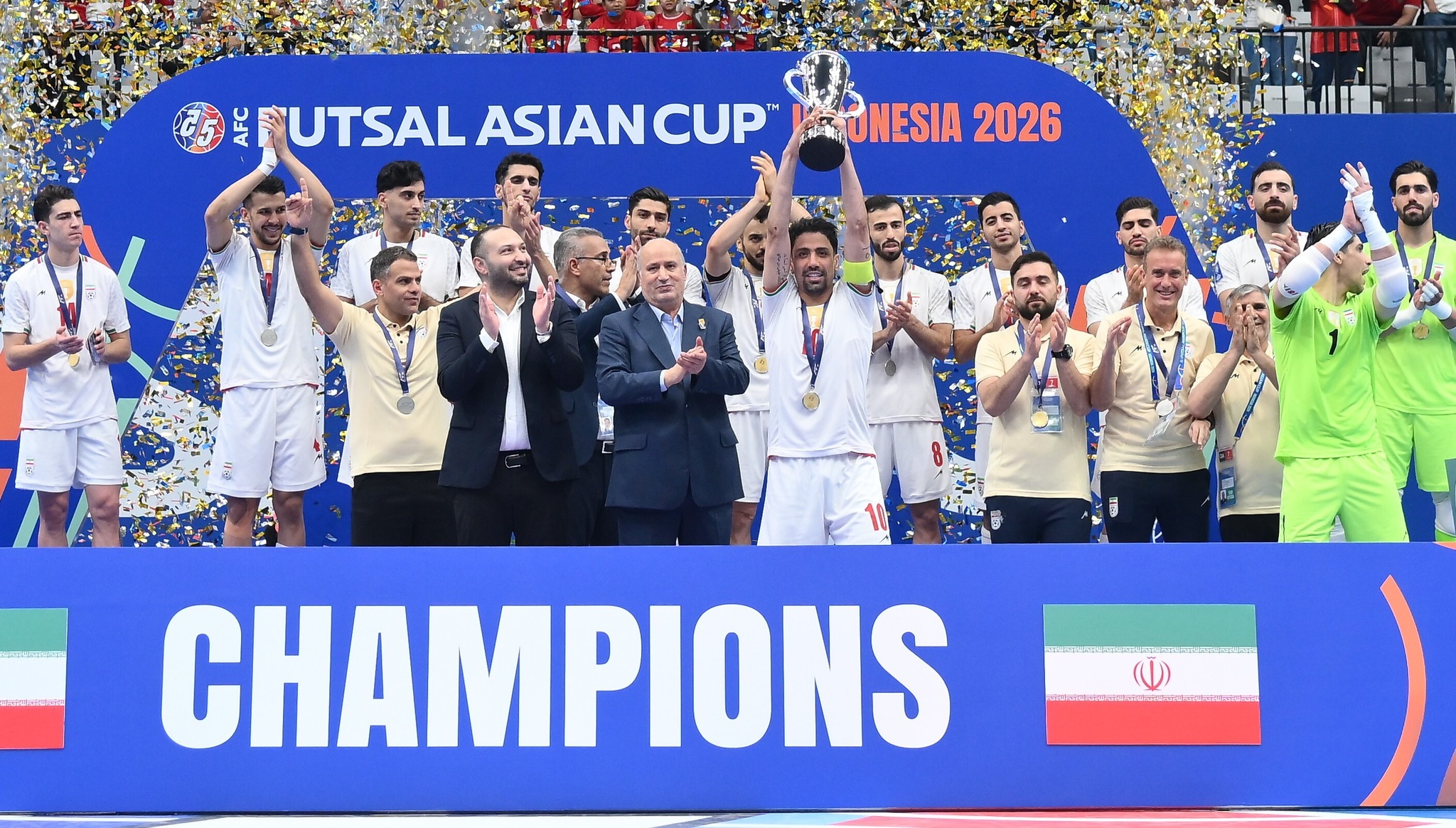
Iran national futsal team 2026 AFC Futsal Asian Cup
A Tournament That Delivered
Staged across two venues, the Indonesia Arena and the Jakarta International Velodrome, the 16-team competition demonstrated the scale of Indonesia’s hosting capability.
Across 31 matches, the tournament produced 166 goals and attracted a confirmed cumulative attendance of 64,381 spectators. Indonesia’s semi-final drew 10,389 fans, setting a new attendance benchmark for the competition in the country.
For Indonesian futsal, those figures carried weight.
On 9 February 2026, the Asian Football Confederation (AFC) formally issued written commendation to Indonesia’s Local Organising Committee and the Football Association of Indonesia (PSSI), praising the professional delivery of the tournament and the hospitality extended to participating teams.
Domestic outlets including Media Indonesia and Detik Sport widely reported that the AFC described the event’s standards as “professional,” reinforcing Indonesia’s growing credibility as a futsal host.
Youth and Sports Minister Erick Thohir publicly noted that AFC officials had commended both the quality of the final and the smooth execution of the tournament. He highlighted consistent fan engagement and operational efficiency as evidence that Indonesia could realistically consider bidding for larger futsal events, including a potential 2028 FIFA Futsal World Cup.
The tournament was therefore framed not as a one-off success, but as institutional validation.
Indonesia’s Run to the Final
On the court, Indonesia recorded its best-ever AFC Futsal Asian Cup finish.
The hosts navigated the group stage before advancing through the knockout rounds to reach the final for the first time in tournament history. Their semi-final victory secured a historic place in the championship match and intensified national attention.
The final itself was one of the most dramatic in recent editions. Indonesia and Iran were locked at 5–5 after extra time before Iran prevailed in the penalty shootout.
For Iran, the victory secured a record-extending 14th continental title. The champions finished the tournament with 27 goals scored, the highest tally among participating nations. Their campaign, however, was not without scrutiny, some analysis noted that Iran conceded 12 goals during the tournament, underlining the increasingly competitive nature of Asian futsal.
For Indonesia, the defeat was interpreted domestically not as failure, but as confirmation of progress. Media headlines consistently referred to the team’s achievement as “historic,” while analysis pieces emphasised the significance of reaching the final on home soil.
Individual Recognition
The tournament’s individual awards reflected both established excellence and Indonesia’s rising stature.
- Saied Ahmad Abbasi (Iran) was named Most Valuable Player.
- Muhammad Osamanmusa (Thailand) finished as top scorer with six goals.
- Indonesia’s Ahmad Habiebie earned the Best Goalkeeper award.
Habiebie’s recognition reinforced the perception that Indonesia’s squad now includes players capable of competing at Asia’s highest level.
National Reaction: Pride with Perspective
Indonesian media coverage combined celebration with measured reflection.
Reports from Antara described thousands of supporters arriving early, waving national flags, and transforming Indonesia Arena into a visibly partisan venue. The record semi-final attendance underlined the scale of public engagement.
Social media echoed that enthusiasm, with tournament-related hashtags trending nationally and supporters expressing pride in the team’s performance.
At the same time, commentary acknowledged areas requiring improvement. One Antara columnist observed that Indonesia “kalah bukan karena lebih lemah, tetapi belum cukup terbiasa menang” (not because they were weaker, but because they are not yet sufficiently accustomed to winning), a succinct assessment of a team still learning to manage decisive moments.
Coach Hector Souto adopted a similarly balanced tone, expressing pride in his squad while recognising the remaining gap between Indonesia and established Asian powers such as Iran and Japan.
The overarching narrative was clear: pride without complacency.
Federation Commitments and Institutional Follow-Through
The Futsal Federation of Indonesia (FFI) moved swiftly to reinforce continuity. FFI chairman Michael Sianipar confirmed that Souto would remain head coach through 2028, positioning the decision as part of a long-term technical strategy.
Meanwhile, PSSI executive Arya Sinulingga confirmed that the federation would cover approximately USD 14,000 in AFC disciplinary fines incurred during the tournament, underscoring futsal’s place within PSSI’s administrative responsibility.
Michael Sianipar also used the moment to call for stronger structural backing, noting that sustained progress would require government support and professionally managed funding systems.
Beyond the men’s programme, FFI has begun preparations for upcoming women’s futsal competitions, including national training camps ahead of regional tournaments, suggesting that 2026 is viewed internally as a development platform rather than a peak.
Sponsors and Commercial Signals
Corporate and private backing followed the team’s performance.
Logistics company Jalur Nugraha Ekakurir (JNE) announced cash bonuses for players and officials. Influencer Atta Halilintar pledged a personal IDR 111,111,111 bonus and encouraged broader sponsor engagement.
These gestures were widely interpreted as signs that futsal’s commercial ecosystem in Indonesia is expanding beyond federation structures.
Continental Context
The tournament’s impact extended beyond Indonesia’s borders.
Following the Asian Cup, Iran climbed to fourth in the FIFA Futsal World Rankings, reaching 1,523 ranking points. Indonesia’s ability to push a top-four ranked nation to penalties reinforced the scale of its progress.
The margins at the summit of Asian futsal appear to be narrowing.
A Foundation, Not a Finish Line
Indonesia did not lift the AFC Futsal Asian Cup trophy. But it achieved something substantial.
Validation that it can host major continental tournaments professionally.
Validation that its national team can compete in a final against Asia’s most decorated side.
Validation that futsal can mobilise tens of thousands of spectators domestically.
Whether this moment becomes a lasting turning point will depend on follow-through, investment in grassroots pathways, continued coaching stability, women’s programme development, and structural funding reform.
For now, the facts are clear:
Indonesia hosted successfully.
Indonesia reached its first final.
Indonesia drew record crowds.
Indonesia earned individual continental honours.
Indonesia strengthened its credibility across Asia.
For a futsal nation seeking acceleration rather than participation, that is a significant step forward.
Organ Donation
Futsal Focus is a supporter of Dáithí Mac Gabhann and his family’s campaign to raise awareness of Organ Donation. We encourage our readers to learn more about Organ Donation: https://www.organdonation.nhs.uk/
Futsal Focus
You can read more articles about International Futsal by going to the top navigation bar or by clicking here
If you like this article and would like to keep updated on Futsal news, developments, etc. You can now follow Futsal Focus via Google News. By following our page which will send you an alert as soon as we publish an article. Please click here and follow us on Google.
You can also keep updated on Futsal news, developments by submitting your email below in the Subscribe to Futsal Focus option.
Follow Futsal Focus by clicking on Facebook, Twitter, or Instagram or on the social media buttons on the website




