











![[Valid RSS]](https://www.futsalfocus.net/wp-content/uploads/2020/01/valid-rss-rogers.png "Validate my RSS feed")

Estimated reading time:12 minutes, 35 seconds
From Hamburg in 2016 to Stuttgart in 2026, two England v Germany friendlies bookend a decade of structural change, contrasting investment models and shifting visibility in the indoor game.
A Fixture That Quietly Tracks a Decade
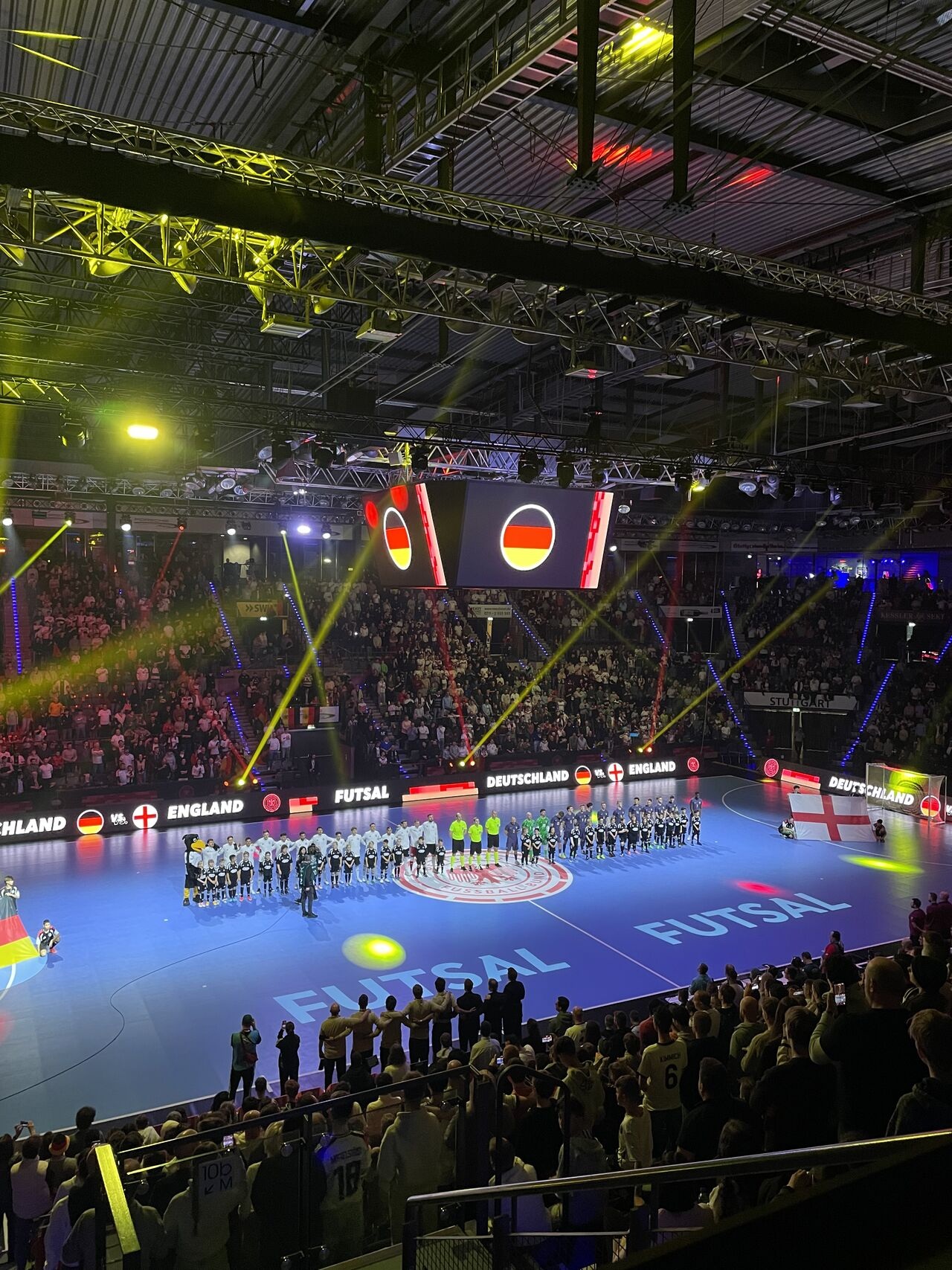
When England’s men stepped onto the court at Stuttgart’s Porsche Arena in February 2026, the occasion was framed as a celebration: ten years since Germany’s senior national futsal team first took the floor, against England, in Hamburg.
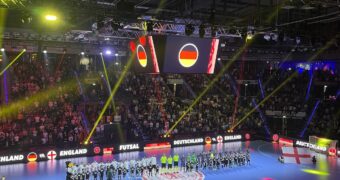
(Main image: Germany v England, Stuttgart’s Porsche Arena – source of the image: Benjamin Stevens, Total Futsal)
On the surface, the comparison is simple. In October 2016, Germany’s debut attracted a sell-out crowd of 2,510. Ten years later, 5,800 spectators filled the Porsche Arena to watch the rematch, setting a new attendance record for German futsal.
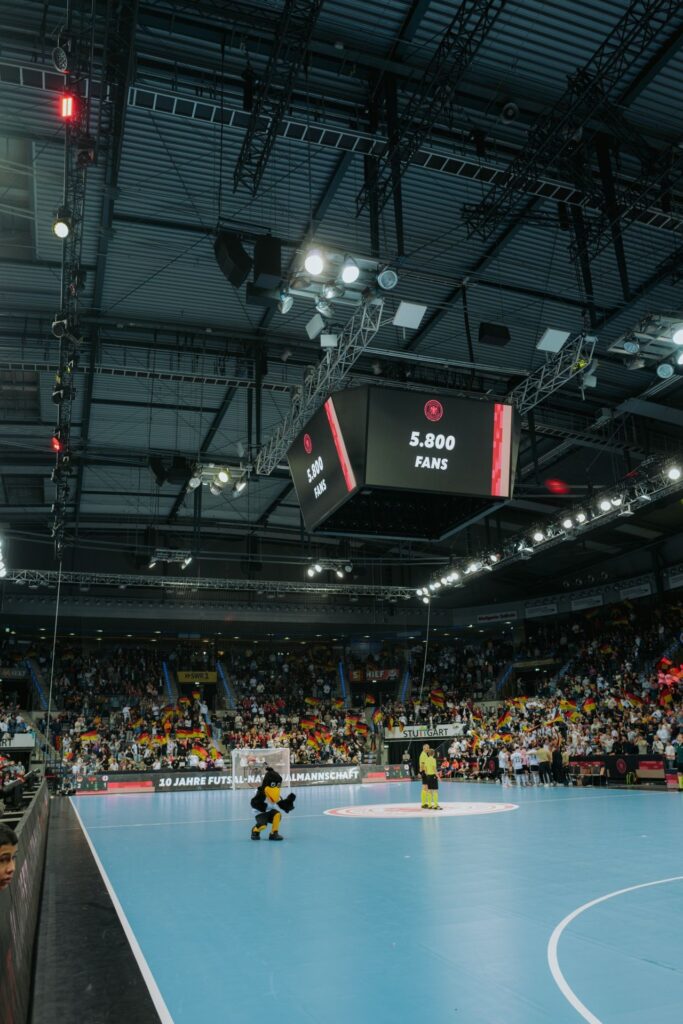
Source of the image: Benjamin Stevens, Total Futsal
But the real story sits beneath those numbers. Across the intervening decade, England and Germany have built, and in England’s case, rebuilt, their futsal ecosystems in markedly different ways. The two fixtures now serve less as a sporting rivalry and more as a useful snapshot of how the game is evolving in two emerging European markets.
Hamburg 2016: Germany’s International Starting Point
Germany’s first official senior international took place on 30 October 2016 at the Inselparkhalle in Hamburg. For the DFB, the night represented a formal entry into the international futsal landscape. For England, it was another away assignment for a programme that already had a longer history in the sport.
The match itself was open and high scoring. England stayed level at 2–2 at half-time, with Doug Reed twice finding the net to keep the visitors in contention. After the break, however, Germany capitalised on defensive errors and pulled away to secure a 5–3 victory in front of the capacity crowd.
Two days later, the teams met again in the same venue. England responded with a more controlled performance and earned a 3–3 draw, with Max Kilman (currently, Premier League player for West Ham United FC) scoring a dramatic late equaliser. The evening also marked Luke Ballinger’s 100th England futsal cap, underlining the continuity within England’s player pool at the time.
At that moment in late 2016, the gap between the two nations’ futsal structures did not appear especially wide. What followed over the next ten years would change that perception.
A Decade of Change Behind the Scenes
The period between Hamburg and Stuttgart was defined less by headline results and more by structural decisions that reshaped the sport’s trajectory in both countries.
In Germany, the DFB moved steadily toward a centrally coordinated model: appointing specialist coaching leadership, building a national league structure and embedding the national team into regular UEFA competition cycles.
England’s pathway proved more turbulent. The decade brought a new national league, pandemic disruption, elite funding cuts and, eventually, a delivery-partner model that shifted much of the sport’s operational responsibility outside the FA’s traditional internal structures.
Understanding that context is essential to interpreting what the 2026 meeting really represented.
England Futsal 2016–2026: Reinvention Under Pressure
England entered the late 2010s with an explicit ambition to grow futsal more systematically. The potential for domestic interest had already been demonstrated in the pre-pandemic period, when a then-record crowd of 1,430 attended England’s Copper Box Arena fixture against Sweden in 2015. The FA’s 2018 “Fast Forward with Futsal” strategy subsequently set out a vision to embed the game more deeply across grassroots and elite levels.
A key pillar of that plan was the launch of the National Futsal Series (NFS) in 2019. The FA described the new competition as part of a wider transformation designed to improve the competition experience, raise standards and move toward a more sustainable league model. The inaugural season began promisingly but was ultimately declared null and void following the COVID-19 pandemic, disrupting early momentum.
The most significant shift came in September 2020, when the FA confirmed that funding would no longer be provided for elite England futsal teams as part of pandemic-era budget decisions. The move had immediate consequences for the national programme and reshaped how international activity could be sustained in the years that followed.
Over time, the governance model evolved further. In December 2022, the FA formalised England Futsal as its licensed delivery partner for many operational aspects of the game, a relationship the FA reaffirmed in 2024 when futsal oversight moved into the Football Development Committee structure. The model left the FA as regulator while England Futsal took on increasing delivery responsibility across development and programme management.
While the structural shift was significant on paper, England Futsal’s work over the following period has been largely focused on building the underlying ecosystem required to sustain the sport.
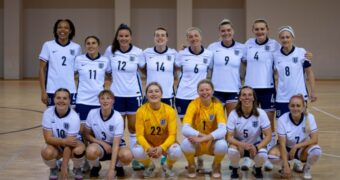
The organisation has overseen the reactivation and management of England’s national team programmes in a financially constrained environment, including supporting the men’s return to UEFA competition and, notably, launching the country’s first senior women’s national futsal team. The women’s side made its international debut in the FIFA Women’s Futsal World Cup qualifying cycle and recorded its first victory with an 8–0 win over Moldova, a milestone widely viewed within the English game as an important step for the sport’s visibility. Germany, by contrast, is still in the earlier stages of establishing a fully comparable senior women’s national futsal programme.
Beneath the senior level, England Futsal has prioritised pathway construction. Its Talent Development Programme has expanded to include U17 and U19 boys’ and girls’ age groups, delivered through regional hubs designed to provide international-level training environments and clearer progression routes. Alongside this, the organisation has begun rolling out a Youth Development Partner network, with an initial cohort of 25 organisations tasked with establishing more consistent junior competition opportunities across the country. England Futsal has itself acknowledged that building a robust nationwide framework is likely to be a three-to-five-year project.
Institutionally, the body has also moved to strengthen its governance footprint, establishing a Community Interest Company structure in 2025 and introducing national commissions covering areas such as equality, welfare, people development and facilities. In parallel, partnerships around safeguarding, coach education and event delivery, including collaboration with Loughborough University to host EURO 2026 qualifiers, illustrate an approach focused heavily on infrastructure and capacity building rather than short-term headline gains.
Taken together, the picture that emerges is of an organisation engaged in substantial foundational work, but doing so within an English futsal landscape that remains financially tight and structurally still in transition. At the domestic level, however, the pyramid remains relatively fragile, with club sustainability and long-term league stability continuing to be cited within the game as ongoing challenges.
A distinctive feature of England’s player pathway over the past decade has been the growing influence of the university game. BUCS futsal has expanded significantly since the mid-2010s, with more than 160 universities now participating across the pyramid. Several members of recent England squads have developed through university programmes, and institutions such as Loughborough now operate multiple men’s and women’s teams alongside National Futsal Series involvement. The model has helped sustain the national player pool, but it also underlines how England’s elite pathway remains notably influenced by the university game, alongside continued contributions from National Futsal Series clubs.
The Visibility Challenge: From Broadcast to Direct Streaming
While governance was shifting, the domestic league was also navigating its own commercial journey.
In September 2021, the National Futsal Series secured a three-year agreement with BT Sport to show selected fixtures live, a notable breakthrough for the sport’s visibility in England. Coverage continued following BT Sport’s transition into TNT Sports, with matches broadcast through the 2023/24 season.
The next phase marked a fundamental change in approach following TNT Sports’ ending their coverage of the NFS, the reasons for which have not been publicly disclosed. From the 2024/25 season, the league moved to its own streaming platform, nationalfutsal.tv, powered by Joymo. The partnership was positioned as the creation of a “digital home” for the sport, with plans to stream the full Tier 1 schedule and eventually hundreds of matches across multiple tiers.
The shift offered control and scale but also placed new demands on production consistency, platform reliability and audience acquisition, challenges familiar to many emerging sports moving from traditional broadcast windows to direct-to-consumer models.
Germany’s Model: Steady Federation-Led Build
While England was reshaping its delivery model, Germany’s futsal structure developed along a more centralised path.
A significant part of Germany’s steadier trajectory can be traced back to a much earlier strategic decision. At its Bundestag in 2013, the German Football Association (DFB) formally standardised futsal as the official indoor format across its structure, mandating that all association hall competitions, from district level through to national championships, be played under FIFA futsal laws. The policy was rolled out in phases, beginning with youth competitions in the 2014/15 indoor season and extending to senior association tournaments from July 2015. While privately organised indoor events were not prohibited, the decision created nationwide regulatory clarity and ensured that the organised football pyramid in Germany was aligned behind a single indoor code, a structural foundation that has underpinned much of the country’s subsequent futsal development.
After the 2016 launch, the DFB quickly embedded the national team into UEFA competition cycles and installed Marcel Loosveld, widely regarded as a specialist futsal coach, to lead the programme. His contract extension through 2026 signalled continuity and institutional backing.
The most significant structural milestone occurred with the introduction of the Futsal-Bundesliga for the 2021/22 season, which replaced the previous championship format with a national top division. The league provided a clearer elite pathway and a consistent domestic environment for national-team players. Beneath the elite level, participation has also broadened following the DFB’s 2013 futsal mandate, with regional associations now running structured competitions involving thousands of players nationwide, although comprehensive national participation figures are not publicly centralised.
Germany’s top tier has also continued to build its digital visibility. Ahead of the 2024/25 season, the DFB confirmed that all Futsal-Bundesliga matches would be streamed live and free of charge on Sportdeutschland.TV, with clubs responsible for producing their own home broadcasts and content aggregated centrally on the platform. The move marked a shift toward full-coverage digital distribution rather than selective television windows and aligned the league with a growing number of emerging indoor competitions adopting direct-to-fan models. While publicly available viewing figures have not been released, the strategy reflects a clear emphasis on accessibility and nationwide reach rather than immediate broadcast revenues. While still largely semi-professional in structure, the competition has begun to attract experienced international players and is viewed within UEFA circles as an emerging second-tier European league.
Commercially, Germany’s futsal project remains in a development phase rather than a major revenue cycle. While the DFB has invested in media production around the Futsal-Bundesliga and, more recently, moved to full free-to-view coverage on Sportdeutschland.TV, there has not yet been a headline title sponsor or major broadcast rights deal attached specifically to the competition. Instead, recent federation moves, including the adoption of new sponsorship-management infrastructure in 2026, suggest a strategy focused on professionalising the commercial framework first, with large-scale monetisation likely to follow only once the league’s audience base is more firmly established.
On the international stage, Germany reached the elite round of FIFA Futsal World Cup qualifying for the first time in the 2024 cycle after defeating Sweden in the play-offs, a tangible competitive step forward for the programme. In UEFA ranking terms, both nations remain outside the continent’s established elite, although Germany’s steady upward trajectory has begun to narrow the historical gap with England.
Stuttgart 2026: A Record Night
Against that backdrop, England’s return to Germany in February 2026 was deliberately framed as an anniversary fixture marking ten years since the Hamburg debut.
The match itself followed a familiar pattern of competitiveness. England struck early through Jeff Adubofour to briefly silence the home crowd. Germany responded through Pedro Strickert before Christopher Wittig gave the hosts the lead. A late goal from Gabriel de Oliveira secured a 3–1 German victory.
Off the court, however, the headline number was unmistakable. The attendance of 5,800 at the Porsche Arena set a new record for German futsal and was widely described by local organisers as a “futsal festival,” complete with strong family attendance and sustained crowd engagement throughout the evening.
For England captain Russell Goldstein, the anniversary fixture also carried personal significance. Speaking in the build-up to the Stuttgart match, he described representing England as “an honour” that should “never be taken for granted,” highlighting the “sacrifice and dedication” required to sustain the programme through the post-COVID years (England Futsal).
Reading the Signals Correctly
It would be overly simplistic to treat one friendly, even a record-breaking one, as definitive proof of long-term direction. But taken together, the Hamburg and Stuttgart fixtures provide a useful lens.
Germany’s trajectory over the decade has been characterised by federation continuity, the creation of a national league and gradual competitive progress. England has been shaped by structural resets, funding withdrawal, league rebuilding and a transition toward a partner-delivery model supported by direct-to-fan media.
Both nations have made progress. Both still face structural questions. But the contrast in how that progress has been organised is now clearly visible.
What Comes Next
The crowd in Stuttgart demonstrated that there is a genuine audience for high-level futsal in Northern Europe when the product is presented effectively. The next phase for both countries will be less about one-off showcase events and more about whether their respective systems can consistently convert visibility into sustained competitive depth and commercial stability.
For England, the key question is whether the evolving partnership model, supported by a player pathway that now draws significantly from both the university game and National Futsal Series clubs, can deliver long-term coherence after a decade of adjustment and financial constraint at the elite level.
For Germany, the challenge is different but equally significant: to build on its more structured federation foundations and translate growing domestic participation and league stability into sustained international progression.
Ten years on from Hamburg, the comparison is no longer theoretical. The two programmes have taken different developmental paths, and the next decade will provide the clearest indication yet of which model can deliver lasting competitive traction.
Organ Donation
Futsal Focus is a supporter of Dáithí Mac Gabhann and his family’s campaign to raise awareness of Organ Donation. We encourage our readers to learn more about Organ Donation: https://www.organdonation.nhs.uk/
Futsal Focus
You can read more articles about International Futsal by going to the top navigation bar or by clicking here
If you like this article and would like to keep updated on Futsal news, developments, etc. You can now follow Futsal Focus via Google News. By following our page which will send you an alert as soon as we publish an article. Please click here and follow us on Google.
You can also keep updated on Futsal news, developments by submitting your email below in the Subscribe to Futsal Focus option.
Follow Futsal Focus by clicking on Facebook, Twitter, or Instagram or on the social media buttons on the website




