











![[Valid RSS]](https://www.futsalfocus.net/wp-content/uploads/2020/01/valid-rss-rogers.png "Validate my RSS feed")

Estimated reading time:5 minutes, 11 seconds
A unified structure, new competitions, and growing commercial momentum signal a turning point for futsal in Brazil.
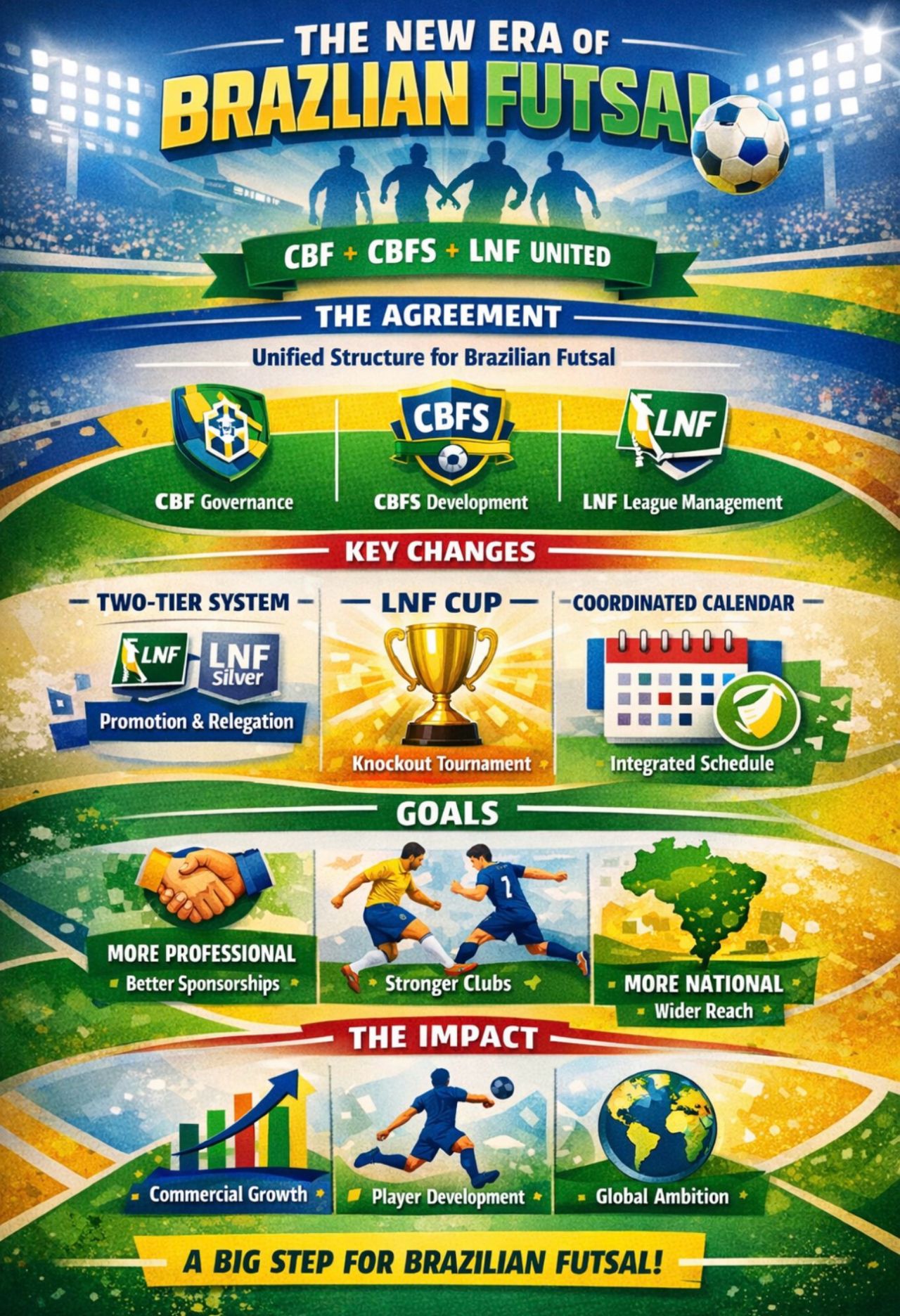
Brazilian futsal is undergoing a historic transformation. For the first time, the CBF, CBFS, and LNF have signed a landmark institutional cooperation agreement, unifying governance and reducing the fragmentation that has long characterized the sport.
Under this new structure:
- The Brazilian Football Confederation (CBF) assumes overall governance and long-term strategic development
- The Confederation of Brazilian Futsal (CBFS) manages regulation, including refereeing, player registration, and state federation coordination
- The Futsal National League (LNF) oversees the organization and commercial development of the national league system
This alignment introduces a redesigned competitive ecosystem:
- Two-tier league system: LNF Gold (top division) and LNF Silver (second division)
- Promotion and relegation introduced for the first time
- Launch of the Copa LNF, a national knockout tournament
A national calendar committee and integrated administrative systems further enhance coordination and operational efficiency.
Commercially, the sport is gaining momentum. Partnerships with Umbro (extended to 2029) and Cresol (naming rights through 2027) highlight growing confidence. All 319 matches of the 2026 season will be broadcast live, expanding futsal’s reach.
With improved governance, stronger commercial appeal, and a refined competition model, Brazilian futsal is positioned for significant professional growth while maintaining its role as a talent incubator and mass-participation sport.
Futsal Enters a New Institutional Era
Historically, Brazilian futsal suffered from institutional fragmentation—overlapping calendars, competing authorities, and inconsistent regulation.
In 2026, this began to change.
The formal cooperation between CBF, CBFS, and LNF represents a structural turning point. As LNF president Fellipe Drommond noted, this moment will be remembered as a “turning point” for the sport.
Each entity now operates within clearly defined, complementary roles:
- CBF: overarching governance, national teams, long-term development
- CBFS: arbitration, player registration, federation support, national competitions
- LNF: management of the professional league system and commercial operations
This alignment creates a unified decision-making framework, reducing inefficiencies and internal conflicts.
New League Structure: LNF Gold and Silver
A major reform of the competitive system was approved in late 2025.
LNF Gold (Top Division)
- 16 teams (reduced from 24)
- Single round-robin format (120 matches)
- Top 4 advance directly to quarterfinals
- Teams ranked 5th–12th enter playoff round
- Bottom 2 relegated automatically
- 14th place enters relegation playoff
LNF Silver (Second Division)
- 16 teams
- Identical format to Gold (120 matches)
- Top 2 promoted automatically
- 3rd place enters promotion playoff
This introduces, for the first time, a formal promotion and relegation system in Brazilian futsal.
Copa LNF: A New Knockout Competition
The newly created Copa LNF adds a national knockout dimension inspired by cup competitions like the FA Cup.
- 32 teams (16 Gold + 16 Silver)
- Single-elimination format
- 31 matches across five rounds
- Final held at a neutral venue
A key innovation:
- Silver division teams host Gold teams in the first round
This increases competitive balance and creates opportunities for upsets, broadening national engagement.
Operational Advancements and System Integration
Beyond structural reform, the new model introduces important operational improvements.
Competitions will now use the CBFS administrative system, including:
- Digital match reports
- Financial documentation
- Centralized competition management
This enhances transparency, efficiency, and standardization across all tournaments.
Calendar Coordination and Governance Expansion
A new national calendar committee has been established to coordinate scheduling across all competitions.
Notably, this committee includes:
- Administrators
- Coaches
- Players
This broader representation aims to:
- Reduce scheduling conflicts
- Avoid competition overlap
- Improve planning for clubs and federations
Given that over 30 competitions were scheduled for 2026, this coordination is essential for sustainable growth.
Unified Refereeing System
The agreement also introduces full refereeing standardization.
- CBFS referees will officiate all LNF competitions
- A single national framework will govern officiating
This ensures:
- Consistency in decision-making
- Reduced disputes
- Improved competitive fairness
Commercial Growth and Media Expansion
The institutional alignment significantly strengthens the commercial appeal of futsal.
Key developments include:
- Full broadcast coverage of all 319 matches in 2026
- Renewal of major sponsorship deals
- Expansion into licensing and media partnerships
Additional ecosystem growth includes:
- Product licensing agreements (e.g., Kalunga)
- Broadcast partnerships (e.g., Xsports as official TV partner)
The LNF has also reported that digital engagement doubled between 2024 and 2025, indicating rapid audience growth.
Geographic Expansion and National Reach
The restructured competition now includes clubs from 10 Brazilian states, doubling the geographic representation compared to previous editions.
This expansion:
- Broadens the national footprint
- Increases regional inclusion
- Strengthens grassroots connections
Cultural Importance and Talent Development
Futsal remains deeply embedded in Brazil’s sporting identity.
- Approximately 10.7 million participants (2021)
- 12 of 23 players in Brazil’s 2018 national football squad had futsal backgrounds
Legendary footballers, including Ronaldo and Neymar, developed their skills in futsal, reinforcing its role as a talent pipeline.
Future Outlook
With improved governance, integrated systems, and a more attractive competitive model, Brazilian futsal is entering a new phase.
The reforms promise:
- Greater professionalization
- Increased investment
- Enhanced competitive quality
- Stronger development pathways
If fully implemented, this transformation could represent the most significant evolution in Brazilian futsal in decades—structurally, commercially, and culturally.
As described by league leadership, the sport is now operating in a “more collaborative and structured environment”, positioning it for sustained growth and global relevance.
Sources
- Official communications from the CBF, CBFS, and LNF
- Brazilian sports media coverage (including Globo Esporte and regional outlets)
- Industry and marketing reports (including MKT Esportivo)
- LNF General Assembly decisions (December 2025 & March 2026)
- Statements from league and federation executives (including Fellipe Drommond and Marcos Madeira)
- Commercial partnership announcements (Umbro, Cresol)
Organ Donation
Futsal Focus is a supporter of Dáithí Mac Gabhann and his family’s campaign to raise awareness of Organ Donation. We encourage our readers to learn more about Organ Donation: https://www.organdonation.nhs.uk/
Futsal Focus
You can read more articles about global futsal by going to the top navigation bar or by clicking here
If you like this article and would like to keep updated on Futsal news, developments, etc then you can now follow Futsal Focus via Google News by following our page which will send you an alert as soon as we publish an article so please click here and follow us on Google.
You can also keep updated on Futsal news, developments, etc then please submit your email below in the Subscribe to Futsal Focus option.
Follow Futsal Focus by clicking on Facebook, Twitter, or Instagram or on the social media buttons on the website




