











![[Valid RSS]](https://www.futsalfocus.net/wp-content/uploads/2020/01/valid-rss-rogers.png "Validate my RSS feed")

Estimated reading time:9 minutes, 5 seconds
How the global game is being rebuilt, and what it means
Futsal is entering a new phase of its development, one defined less by what happens on the court, and more by how the game is structured off it.
Across several of the sport’s leading nations, the question is no longer simply how competitions are played, but how they are designed, governed and commercialised. League formats are being rethought, calendars expanded, governance models rewritten and media strategies pushed to the forefront. What is emerging is not a series of isolated reforms, but a broader shift in how futsal defines itself as a professional sport.
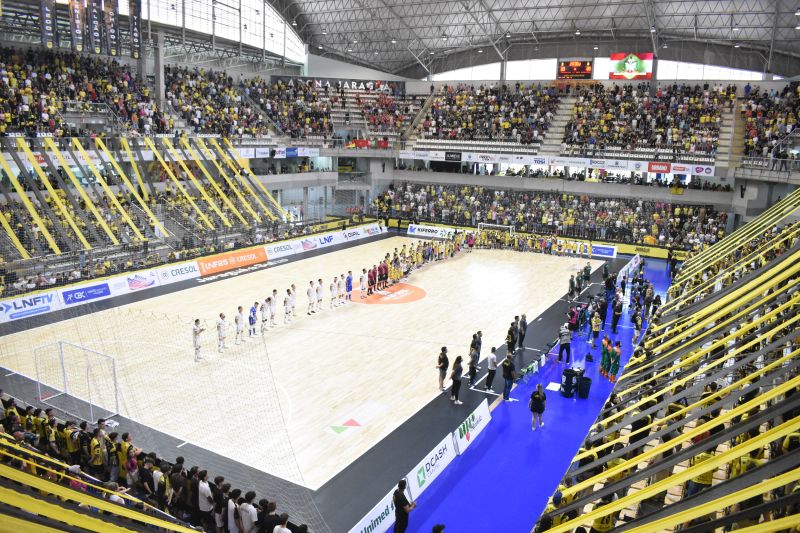
(Main picture: Arena partners with LNF to elevate Brazilian Futsal competitions. Picture credit: Paulo Sauer)
The developments in Spain, Brazil and France offer three distinct versions of that shift. Taken together, they suggest that futsal is moving toward a more systematised, football-like model, but without yet resolving whether that model can be sustained within the sport’s economic reality.
Spain: redefining the meaning of a league
Reporting by Xavi Sidro for Radio Castellón via Cadena SER has outlined a potential restructuring of Spanish futsal that, if approved, would significantly alter the current competition model.
In Spain, the debate is the most visible because it focuses on competition format itself. Real Federación Española de Fútbol has opened discussions with top-division clubs around a proposal that would fundamentally change the structure of the domestic league. The proposal, which remains under discussion and subject to formal approval processes, would replace the traditional single-table season with two independent tournaments, Apertura and Clausura, each producing a champion, followed by a final stage to determine an overall winner.
As reported, the model would also include a rebranding of the competition, referred to in reporting as Liga Prime Futsal, alongside changes to relegation based on aggregated performance across both tournaments, and the removal of the Copa del Rey in favour of an expanded Copa de España. These elements are part of a broader proposal rather than confirmed policy.
The reporting further indicates that each tournament winner would qualify for the UEFA Futsal Champions League. In the event that the same club wins both tournaments, the second European place would be allocated based on coefficient criteria.
The stated rationale behind the proposal is to create more decisive matches and increase the commercial appeal of the competition. However, the introduction of multiple champions represents a departure from the current single-table format and would require clear regulatory definition, particularly in relation to how the “winner of the top domestic league” is identified for European competition purposes.
The discussions are taking place within a wider context of ongoing structural and organisational developments in Spanish futsal. At the same time, the commercial environment surrounding the sport continues to evolve, with broadcasting rights increasingly treated as centralised assets subject to regulatory oversight.
At this stage, the proposal remains part of a consultative process with clubs, and its final form, or implementation timeline, has not yet been confirmed.
Brazil: scaling the system, not just the schedule
Brazil’s trajectory is different, but no less significant. The Liga Nacional de Futsal is not redesigning its competition in conceptual terms; it is expanding and restructuring it within a newly aligned national framework. The 2026 season is described as the largest in the league’s history, featuring 32 teams across two divisions, LNF Gold and LNF Silver, and a calendar of 319 matches across competitions.
This expansion is taking place alongside a significant institutional shift. For the first time, a formal cooperation agreement has been established between the Confederação Brasileira de Futebol (CBF), the Confederação Brasileira de Futebol de Salão (CBFS), and the LNF. The agreement defines complementary roles across the system, with the CBF responsible for overarching governance and long-term strategy, CBFS overseeing regulation including refereeing and registrations, and the LNF managing the organisation and commercial development of the national league structure.
The redesigned competitive ecosystem introduces a formal promotion and relegation system for the first time, linking the two divisions through automatic movement and playoff mechanisms. It also includes the launch of the Copa LNF, a national knockout competition featuring clubs from both tiers.
Operationally, the new model integrates administrative systems through the CBFS platform, including digital match reporting and centralised competition management. A national calendar committee, with representation from administrators, coaches and players, has been established to coordinate scheduling across competitions and reduce conflicts within an increasingly dense calendar.
Commercially, the sport is gaining momentum. All 319 matches of the 2026 season are set to be broadcast live, supported by a mix of free-to-air broadcasting and digital distribution. Long-term partnerships, including naming rights agreements and supplier deals, further embed commercial partners into the league’s identity.
A further indicator of this shift is the league’s approach to infrastructure. Through a strategic partnership with Arena Events + Venues, all 32 arenas used across the LNF Cresol divisions are undergoing a comprehensive assessment, covering playing surfaces, lighting, facilities and overall event experience. The initiative is designed to standardise venue quality and improve conditions for players, officials and supporters, while also supporting broadcast requirements and commercial development.
Brazil’s model demonstrates what happens when professionalisation is approached as a coordinated system rather than a single reform. However, it also introduces new pressures. Expanding the calendar, increasing travel demands and raising operational standards place additional strain on clubs and players. The long-term sustainability of this model will depend not only on growth in visibility and revenue, but on whether that growth can offset the increased structural demands placed on the ecosystem.
France: building the foundations first
The approach in France is less focused on competition format and more on long-term system development. The Fédération Française de Football (FFF) has positioned futsal as a strategic priority within a structured three-year plan running to 2028, built around participation growth, elite development and increased visibility.
The plan is defined by clear quantitative targets. In 2026, France reports approximately 50,000 licensed futsal players, a figure that has doubled in four years, alongside around 200,000 school participants through the national schools system. The federation’s objective is to reach 100,000 licensed players by 2032, supported by an initial €8 million investment phase and a target of €10 million annually by 2028–2029, an unusually explicit level of financial planning for futsal at federation level.
Structurally, the plan introduces significant expansion at elite level. A new national women’s futsal championship and a U19 national competition are scheduled to launch in 2026, alongside the development of a second Pôle France training centre to strengthen the national team pathway. These measures are complemented by the continued development of a club licensing framework aimed at consolidating elite structures.
Media strategy is treated as a central pillar of the plan. The federation has committed to financing a dedicated broadcast channel for D1 futsal, with the stated aim of increasing visibility and improving the sport’s attractiveness to sponsors.
The plan also emphasises the relationship between futsal and traditional football, positioning the two formats as complementary pathways for player development rather than competing systems. At the elite level, the strategy is framed within a longer-term ambition of international competitiveness, including preparation for potential inclusion of futsal in the 2032 Olympic Games in Brisbane.
What distinguishes the French approach is its emphasis on structure, investment and measurable growth. Rather than prioritising competition redesign, the focus is on building the underlying conditions required for a sustainable professional ecosystem.
Convergence: futsal’s football-like evolution
Across these three cases, a consistent pattern emerges. Futsal is adopting mechanisms that are familiar from football: stronger league branding, expanded competition calendars, centralised or coordinated governance structures, diversified broadcast strategies and infrastructure standards tied to commercial outcomes. These are not superficial changes. They reflect an attempt to move from fragmented development toward a more integrated and scalable model.
The economic tension beneath the surface
However, adopting these mechanisms does not automatically resolve the challenges that futsal faces. Football’s structures are supported by decades of commercial growth, large audiences and established revenue streams. Futsal operates within a different economic context, where matchday income and broadcast revenues are typically more limited.
This creates a fundamental constraint. As leagues professionalise, costs increase, through travel, staffing, production requirements and facility upgrades. Unless revenue streams expand at a comparable rate, the gap between ambition and sustainability can widen rather than close.
Different solutions, same problem
This is where the current wave of reform needs to be assessed more critically. The question is not simply whether these changes make leagues more attractive or more dynamic. It is whether they create systems that can endure over time.
In Spain, that means resolving how a more complex competition format aligns with governance clarity and European competition requirements. In Brazil, it means ensuring that expansion does not outpace the financial capacity of clubs and the broader ecosystem. In France, it means translating structured investment into tangible growth in visibility, engagement and revenue.
Other national models underline the importance of these choices. Portugal, for example, combines playoff structures and commercial partnerships while maintaining a clear and singular league champion, preserving alignment with European frameworks. Italy has focused on centralised media distribution to strengthen visibility and control over its product. These examples suggest that there is no single path to professionalisation, but they also highlight the importance of coherence between structure, governance and commercial strategy.
The test still to come
Futsal is no longer at a stage where growth alone is the objective. The sport is now confronting a more complex challenge: how to build systems that can support that growth without undermining it.
The reforms currently underway are part of that process. They reflect ambition, experimentation and, in some cases, necessity. What they do not yet provide is a definitive answer.
Whether futsal is moving toward a sustainable professional model will not be determined by how bold these changes are, but by whether the systems they create remain stable under pressure.
That is the test that still lies ahead.
Organ Donation
Futsal Focus is a supporter of Dáithí Mac Gabhann and his family’s campaign to raise awareness of Organ Donation. We encourage our readers to learn more about Organ Donation: https://www.organdonation.nhs.uk/
Futsal Focus
You can read more articles about global futsal by going to the top navigation bar or by clicking here
If you like this article and would like to keep updated on Futsal news, developments, etc then you can now follow Futsal Focus via Google News by following our page which will send you an alert as soon as we publish an article so please click here and follow us on Google.
You can also keep updated on Futsal news, developments, etc then please submit your email below in the Subscribe to Futsal Focus option.
Follow Futsal Focus by clicking on Facebook, Twitter, or Instagram or on the social media buttons on the website




