










![[Valid RSS]](https://www.futsalfocus.net/wp-content/uploads/2020/01/valid-rss-rogers.png "Validate my RSS feed")

Estimated reading time:6 minutes, 25 seconds
An investigation into Japan’s futsal infrastructure reveals a system that outgrew its own data
Why This Question Keeps Coming Up
Over the years, one theme has come up again and again in conversations around grassroots futsal.
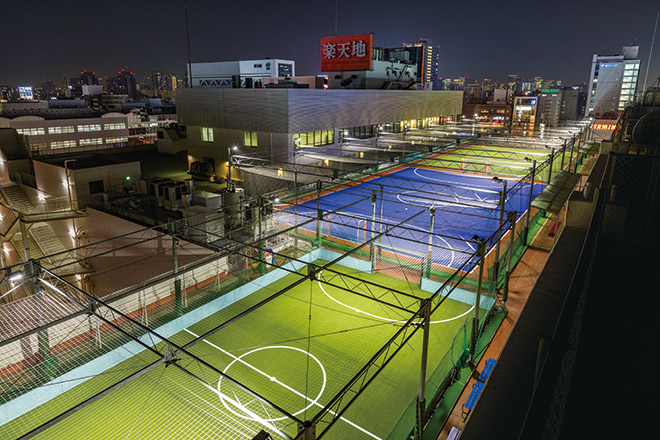
(Main picture and source: Rakutenchi Futsal Court Kinshicho)
People involved in developing the game, coaches, operators, federation staff, regularly point to Japan. And almost always, the same question follows:
Is it true that futsal courts are everywhere in Japan?
Having lived there for four years, I have been asked that question more times than I can count. The assumption is always the same, that Japan has quietly built a dense, accessible futsal infrastructure that other countries simply don’t have.
But assumptions aren’t answers.
So this article is the result of going back and doing the work properly, digging through governing body material, industry data, and nationwide facility listings to answer a question that, on the surface, should be simple:
Has Japan actually built more than 1,000 outdoor futsal courts?
What follows is not just an answer, but an insight into why that answer is harder to pin down than it should be.
Japan’s Futsal Boom Has a Number Problem
Walk through Tokyo on a weeknight and you’ll see it everywhere, five-a-side games under floodlights, rooftop pitches above shopping centres, artificial turf squeezed into spaces that were never meant for football or futsal.
Futsal in Japan is not emerging. It is already built into the fabric of the country.
And yet, ask a simple question, how many outdoor futsal courts exist nationwide?, and the answer becomes surprisingly unclear.
There is no official number. No national database. No governing body figure you can point to with certainty.
But when you follow the data trail, through industry records, federation signals, and nationwide directories, a consistent reality begins to take shape:
Japan has very likely built more than 1,000 outdoor futsal courts.
The catch? It was never formally counted.
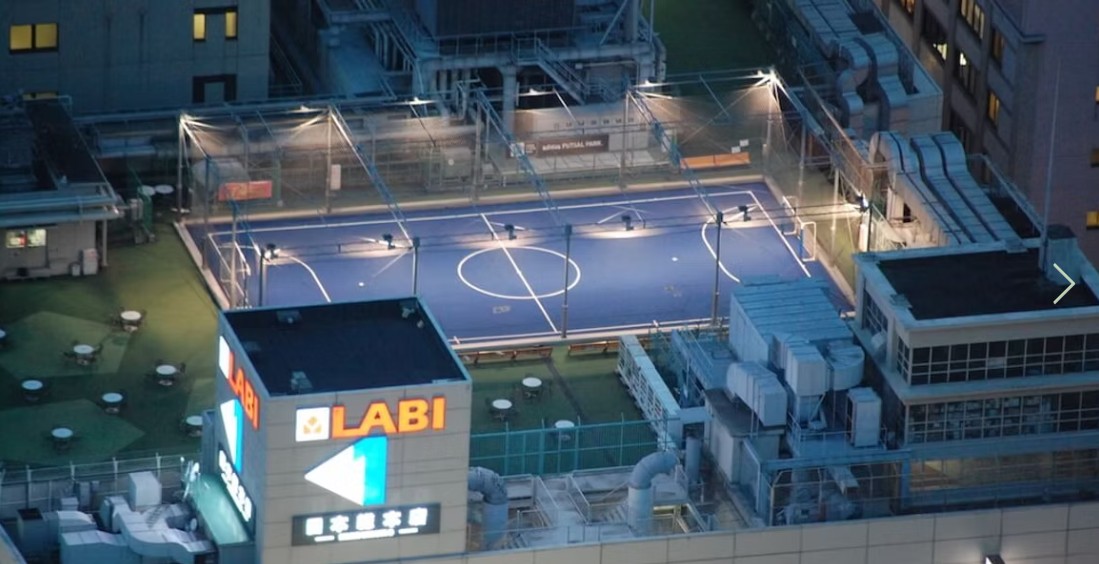
Source of the image: www.bonita.toky
Why the Data Doesn’t Exist
At the centre of the issue is structure.
The Japan Football Association oversees futsal competitively and tracks participation in detail. But infrastructure sits outside a single system.
Instead, futsal courts are absorbed into overlapping categories:
- Commercial futsal centres
- Rooftop recreational facilities
- Municipal sports complexes
- Multi-purpose indoor halls
This fragmentation creates a statistical blind spot.
A futsal court in Japan might be:
- A permanent outdoor artificial-turf pitch
- A rooftop installation above a retail complex
- A temporary configuration inside a gymnasium
Each of these can be counted, or not counted, depending on the source.
Which is why, officially, the number doesn’t exist.
The Evidence Starts in the Mid-2000s
To understand where Japan stands today, you have to go back.
Industry tracking from 2006 reported:
- Around 450 futsal facilities
- Approximately 1,000 playable pitches nationwide
This is a critical data point, and one that often goes unnoticed.
At that time, Japan’s futsal growth was driven largely by:
- Outdoor artificial turf developments
- Commercial five-a-side venues
- Rapid urban adoption
Indoor, multi-use integration was less dominant than it is now.
Which leads to a reasonable conclusion:
Japan likely approached, or reached, 1,000 largely outdoor futsal courts nearly two decades ago.
The Rooftop Model That Changed Everything
One of the defining features of Japan’s futsal infrastructure is not just how much was built, but where it was built.
In 2001, Tokyo Corporation opened a rooftop futsal facility in Tokyo, widely regarded as the country’s first.
It set a blueprint that would be repeated nationwide:
- Use unused rooftop space
- Install artificial turf
- Add lighting
- Create a bookable futsal pitch
In dense urban environments where land is scarce, this model scaled rapidly.
By the late 2000s, rooftop courts had become a defining feature of Japanese futsal, particularly in Tokyo, Kanagawa, and Osaka.
And crucially, they are counted as outdoor courts.
Today’s Numbers: What the Directories Reveal
Without an official registry, the most reliable modern picture comes from aggregated facility directories.
One nationwide platform lists:
- 1,180 futsal facilities
- Each tagged by court type (outdoor, indoor, rooftop)
- Each showing the number of pitches per venue
On the surface, that number alone doesn’t answer the question.
But look closer.
Many facilities are multi-pitch:
- Small sites: 1 court
- Standard venues: 2–3 courts
- Larger complexes: 4–7 courts
Which means the total number of playable courts is significantly higher than the number of facilities.
Reconstructing the Real Figure
To move from listings to reality, estimates have to be built carefully.
Using conservative assumptions:
- 1.5 to 2.0 courts per facility
- 60% to 75% of courts classified as outdoor or rooftop
The resulting range is:
- ~1,060 outdoor courts (low estimate)
- ~1,770 outdoor courts (high estimate)
Even at the lowest end, the threshold is clear:
Japan has surpassed 1,000 outdoor futsal courts.
And that estimate accounts for:
- Overcounts (closed venues still listed)
- Undercounts (facilities not captured in directories)
Demand Has Never Been the Issue
Infrastructure growth in Japan has been driven by sustained participation.
The Japan Football Association continues to report strong futsal engagement across all prefectures, supported by:
- Grassroots competitions
- Recreational leagues
- Programmes like “Enjoy 5”
At the professional level, the launch of the F.League in 2007 gave the sport national visibility and legitimacy.
The result is a feedback loop:
- More players → more demand
- More demand → more facilities
- More facilities → wider access
The Problem With Counting “Courts”
Even with strong evidence, there is still no definitive number.
Because in Japan, a “futsal court” is not always a fixed object.
Municipal facilities regularly list:
- “Futsal: 1 court”
But that may refer to:
- A basketball arena reconfigured for futsal
- A shared indoor space used intermittently
At the same time:
- A rooftop complex with five pitches may be listed as one facility
This inconsistency creates a structural problem:
Japan’s futsal infrastructure can be experienced, but not precisely measured.
So Has Japan Built Over 1,000 Outdoor Courts?
All credible indicators point in the same direction:
- 1,000 pitches reached as early as 2006
- 1,180 facilities listed today – though likely much, much more than this!
- Multi-pitch venues widespread
- Outdoor and rooftop courts dominant in commercial models
The conclusion is clear:
Yes, Japan has almost certainly built more than 1,000 outdoor futsal courts.
The Bigger Story Isn’t the Number
What matters isn’t just that Japan crossed the 1,000 mark.
It’s how it happened.
Not through central planning.
Not through a national infrastructure strategy.
But through:
- Urban adaptation
- Commercial innovation
- Cultural adoption of the small-sided sport
Japan didn’t set out to build 1,000 futsal courts.
It built an environment where futsal could exist anywhere.
And in doing so, it created one of the most extensive, and least formally documented, futsal infrastructures in the world.
Organ Donation
Futsal Focus is a supporter of Dáithí Mac Gabhann and his family’s campaign to raise awareness of Organ Donation. We encourage our readers to learn more about Organ Donation: https://www.organdonation.nhs.uk/
Futsal Focus
You can read more articles about global futsal by going to the top navigation bar or by clicking here
If you like this article and would like to keep updated on Futsal news, developments, etc then you can now follow Futsal Focus via Google News by following our page which will send you an alert as soon as we publish an article so please click here and follow us on Google.
You can also keep updated on Futsal news, developments, etc then please submit your email below in the Subscribe to Futsal Focus option.
Follow Futsal Focus by clicking on Facebook, Twitter, or Instagram or on the social media buttons on the website




